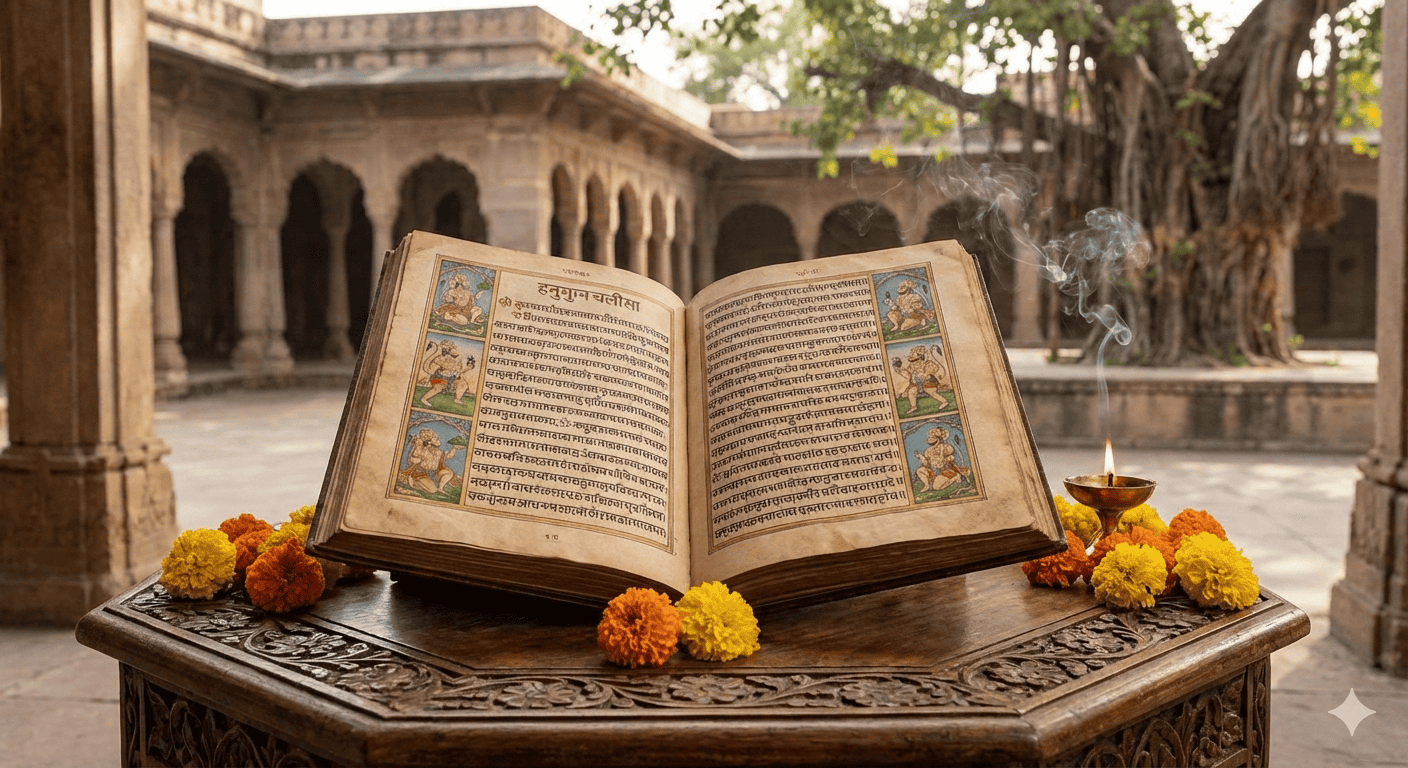

Introduction to Anjaneya Chalisa
In the vast and luminous ocean of Hindu devotional literature, few hymns shine as brightly, as enduringly, and as universally as the Anjaneya Chalisa. Known to millions across the world as the Hanuman Chalisa, this sacred composition bears an equally powerful and profoundly meaningful name when called by the name of its divine subject — Anjaneya, the beloved son of Mata Anjani.
The name Anjaneya is not merely an alternate title. It is a declaration of lineage, love, and identity. While Hanuman speaks of his role as the mighty one with a strong jaw, and Pavanputra honors his celestial birth as the son of the Wind God Vayu, the name Anjaneya reaches deeper into the heart of devotion — it remembers a mother’s love, a mother’s prayers, and the extraordinary being who emerged from her tapas and grace. To call this hymn the Anjaneya Chalisa is to approach Lord Hanuman not only as a warrior or a protector, but as a son, a servant, and a soul of boundless compassion.
This Anjaneya Chalisa was composed in the 16th century by the great poet-saint Goswami Tulsidas, one of the most celebrated figures in the entire history of Indian literature. Tulsidas was a devoted disciple of Lord Rama, and his works — most notably the magnificent Ramcharitmanas — transformed the spiritual landscape of North India and beyond. The Anjaneya Chalisa, though brief in comparison to his larger compositions, is in many ways his most intimate gift to the world. It is a prayer that the humblest of devotees can carry in their heart, recite at dawn, and return to in their darkest hour.
The hymn consists of forty chaupais — devotional quatrains — framed by an opening doha and a closing doha. The word Chalisa itself is derived from the Hindi word for forty, chalis, directly referencing the forty verses that form the body of this prayer. Each chaupai is a complete world unto itself, illuminating a different facet of Anjaneya’s divine personality — his colossal strength, his razor-sharp wisdom, his absolute surrender to Lord Rama, and his infinite compassion for those who seek his grace.
What makes this hymn remarkable beyond all others is not merely its content, but its accessibility. Tulsidas made a conscious and historic decision to compose the Anjaneya Chalisa not in Sanskrit — the classical language of priests, scholars, and sacred texts — but in Awadhi, the living language of ordinary people. This was an act of spiritual revolution. In an age when religious knowledge was often locked behind the walls of Sanskrit literacy, Tulsidas handed the keys of devotion directly to the common devotee. A farmer in the fields, a mother at the hearth, a child at the riverbank — all could chant these verses, understand their meaning, and feel Anjaneya’s presence in their lives. That choice, made over four centuries ago, continues to echo in every home, temple, and heart where this hymn is recited today.
Whether you discover this sacred hymn for the first time on this page, or whether you have been reciting it since childhood, the Anjaneya Chalisa has something to offer you every single time you return to it. If you have ever stood in the incense-filled air of a Hanuman temple — perhaps at a powerful and ancient shrine like Sri Anjaneya Swamy Devasthana in Budigere, Bangalore — and felt your heart grow quieter and your mind grow clearer, then you have already experienced what these forty verses carry within them.
Bookmark this page. Read it daily. Let it become your companion.
The Language of the Anjaneya Chalisa: Why Awadhi Matters
To truly appreciate the Anjaneya Chalisa, one must understand the language in which it was written. The original text is composed in Awadhi, a dialect of the broader Hindi linguistic family spoken primarily in the Awadh region of present-day Uttar Pradesh, in cities such as Ayodhya, Lucknow, and Faizabad. This is no coincidence. Ayodhya is the birthplace of Lord Rama himself, and by choosing Awadhi, Tulsidas was not only speaking to the people of that land but also giving the prayer the flavor and fragrance of Rama’s own home.
Awadhi is a language of remarkable literary beauty. It has a natural musicality — a rhythmic flow that makes it ideally suited to the chaupai and doha forms that Tulsidas mastered. The vowel sounds are open and resonant, the consonants gentle yet firm. When the Anjaneya Chalisa is chanted correctly in Awadhi, the very sound of the language becomes devotional, almost like the hum of a veena string that has been perfectly tuned. This is why the transliteration provided in this article uses careful phonetic rendering — so that even readers unfamiliar with Devanagari script can come close to the original sound and experience the vibrations that generations of devotees have found transformative.
Awadhi is also the language of the Ramcharitmanas, Tulsidas’s greatest work. By composing both the Ramcharitmanas and the Anjaneya Chalisa in the same language, Tulsidas created a unified devotional universe — one in which Rama’s story and Anjaneya’s glory inhabit the same linguistic world, the same spiritual breath.
The Name Anjaneya: A Tribute to a Mother’s Love
Before we enter the hymn itself, let us sit for a moment with the name Anjaneya.
Mata Anjani was a celestial apsara who, owing to a sage’s curse, was born on earth. Through years of deep tapas and unwavering prayer to Lord Shiva, she sought a divine son who would be blessed with extraordinary virtues. Her prayer was answered through the grace of Vayu, the Wind God, and the divine will of Lord Shiva himself. The child born to her carried within him the energy of the wind, the blessing of Shiva, and the heart of a devotee who would spend his entire existence in service to Lord Rama.
Anjaneya — son of Anjani — is thus a name rooted not in power or conquest, but in love and longing. It reminds us that behind every great soul is a mother’s prayer. It reminds us that the mightiest warrior in all of creation was, first and always, a child cherished by his mother. When we call him Anjaneya, we approach him with that tenderness, and he responds in kind.
Structure of the Anjaneya Chalisa
The Anjaneya Chalisa follows a precise literary architecture that reflects both Tulsidas’s poetic genius and the deeper logic of devotion.
The composition opens with a doha — a two-line couplet — in which Tulsidas invokes his Guru’s grace and dedicates his efforts to singing the pure glory of Lord Rama. This opening act of humility is deliberate and instructive. Tulsidas is not claiming authorship of a great work. He is positioning himself as a student, a vessel, someone who has cleansed his mind through the dust of his teacher’s feet and is now ready to receive and transmit divine wisdom. This is the proper beginning of all sacred endeavor.
The body of the Chalisa consists of forty chaupais, each consisting of four lines arranged in two rhythmic pairs. Taken together, these forty verses form a complete portrait of Anjaneya — his appearance, his birth, his education, his feats during the search for Sita, his role in the Lanka war, his relationship with Rama, his capacity to grant blessings, and his eternal, unbroken devotion. It is both a biography and a prayer, both a story and a mantra.
The Chalisa closes with a second doha — a concluding couplet — in which Tulsidas prays for Anjaneya to reside in his heart along with Rama, Lakshman, and Sita. This closing is a moment of complete surrender, an act of inviting the divine to take up permanent residence within oneself. It is, in its simplicity, one of the most beautiful conclusions in all of devotional literature.
Spiritual Significance: Why the Anjaneya Chalisa Transforms Lives
Across four centuries and countless generations, the Anjaneya Chalisa has proven itself not merely as a religious text but as a living spiritual tool. Its power operates on multiple levels simultaneously.
At the level of the mind, regular chanting of the Anjaneya Chalisa creates a shift in mental orientation. The practitioner moves, gradually but unmistakably, from anxiety toward confidence, from scattered attention toward focused awareness, from self-doubt toward a quiet inner courage. This is not mysticism — it is the natural consequence of directing the mind daily toward an archetype of absolute strength and absolute surrender. Anjaneya feared nothing because he had given everything to Rama. Chanting his Chalisa is, in effect, practicing that orientation.
At the level of the spirit, the Anjaneya Chalisa is a path of bhakti, of devotional love. It does not demand scholarship or ritual expertise. It asks only for faith and consistency. Tulsidas himself writes that whoever recites the Chalisa a hundred times is freed from bondage and attains great happiness — and the freedom he speaks of is not merely material but existential, the freedom from the inner chains of fear, ego, and attachment.
At the level of protection, the tradition holds that Anjaneya’s name is itself a shield. Verse 24 states clearly that evil spirits dare not approach where Mahaveer’s name is chanted. Verse 22 promises that all happiness is attained by taking refuge in him, and that one need fear nothing with Anjaneya as protector. Whether one interprets these verses literally or metaphorically, their effect on the practitioner is real — a sense of being held, guarded, and accompanied.
The Anjaneya Chalisa is best recited on Tuesdays and Saturdays, days considered especially auspicious for Hanuman worship, though devotees chant it every day without restriction. A single recitation takes approximately seven to ten minutes, making it one of the most time-efficient yet profoundly effective spiritual practices available to any seeker.
Benefits of Reciting the Anjaneya Chalisa Daily
The benefits of chanting this sacred hymn flow across body, mind, and spirit. Among the most widely acknowledged are the removal of fear and anxiety, which dissolves with consistent practice as the mind anchors itself in Anjaneya’s fearless presence. The hymn also provides a powerful sense of protection, creating what devotees describe as a divine shield around oneself and one’s family. It grants strength and resilience during times of difficulty, inspiring the practitioner to act with courage rather than retreat in despair. Through its rhythmic repetition, it sharpens focus and discipline — the very qualities that Anjaneya himself embodies in his tireless, perfect service to Rama. For those on a spiritual path, it deepens devotion and opens the heart to a direct, personal experience of the divine. And for those who carry the accumulated grief of many years, the hymn promises — as verse 33 states — that devotion to Anjaneya frees one from sorrows spanning many lifetimes.
🕉 Full Anjaneya Chalisa | Original Awadhi Text, Transliteration & English Meaning
The verses below are presented in their original Awadhi text written in Devanagari script, followed by a phonetic English transliteration for correct pronunciation, and the English meaning of each verse. This is the same sacred composition known widely as the Hanuman Chalisa, presented here in its complete, authentic form.
🌸 Opening Doha
Awadhi Text: श्रीगुरु चरन सरोज रज, निज मनु मुकुरु सुधारि। बरनऊँ रघुबर बिमल जसु, जो दायकु फल चारि॥
Transliteration: Shree Guru Charan Saroj Raj, Nij Manu Mukuru Sudhaari Baranau Raghubar Bimal Jasu, Jo Daayaku Phal Chaari
Meaning: I cleanse my mind — like polishing a mirror — with the dust of my Guru’s lotus feet, and sing the pure glory of Lord Rama, which bestows the four fruits of life: Dharma (righteousness), Artha (prosperity), Kama (fulfillment), and Moksha (liberation).
1
जय हनुमान ज्ञान गुन सागर। जय कपीस तिहुँ लोक उजागर॥
Jai Hanuman Gyaan Gun Saagar Jai Kapis Tihun Lok Ujaagar
Hail Anjaneya, ocean of wisdom and virtue, whose glory illuminates all three worlds.
2
राम दूत अतुलित बल धामा। अंजनि पुत्र पवनसुत नामा॥
Ramdoot Atulit Bal Dhaamaa Anjani Putra Pavan Sut Naamaa
Messenger of Rama, abode of immeasurable strength — you are known as the son of Anjani and of the Wind God.
3
महाबीर बिक्रम बजरंगी। कुमति निवार सुमति के संगी॥
Mahabeer Bikram Bajrangi Kumati Nivaar Sumati Ke Sangi
O mighty hero Bajrangi, you remove evil thinking and are the eternal companion of wisdom and good sense.
4
कंचन बरन बिराज सुबेसा। कानन कुंडल कुंचित केसा॥
Kanchan Baran Biraaj Subesaa Kaanan Kundal Kunchit Keshaa
Golden-hued and beautifully dressed, you wear earrings and have naturally curling hair.
5
हाथ वज्र औ ध्वजा बिराजे। काँधे मूँज जनेऊ साजे॥
Haath Bajra Aur Dhvaja Biraaje Kandhe Moonj Janeu Saaje
You hold a thunderbolt and a flag in your hands, and a sacred thread of munja grass adorns your shoulder.
6
संकर सुवन केसरी नंदन। तेज प्रताप महा जग वंदन॥
Sankar Suvan Kesari Nandan Tej Pratap Maha Jag Vandan
Son of Lord Shiva and of Kesari, your radiance and glory are revered and worshipped throughout the universe.
7
विद्यावान गुनी अति चातुर। राम काज करिबे को आतुर॥
Vidyaavaan Guni Ati Chatur Ram Kaaj Karibe Ko Aatur
Endowed with learning, virtue, and extraordinary cleverness, you are ever eager and ready to serve Lord Rama’s mission.
8
प्रभु चरित्र सुनिबे को रसिया। राम लखन सीता मन बसिया॥
Prabhu Charitra Sunibe Ko Rasiya Ram Lakhan Sita Man Basiya
You delight in listening to Rama’s deeds and dwell eternally in the hearts of Rama, Lakshman, and Sita.
9
सूक्ष्म रूप धरि सियहि दिखावा। बिकट रूप धरि लंक जरावा॥
Sookshma Roop Dhari Siyahi Dikhawa Vikat Roop Dhari Lank Jarawa
You appeared before Mother Sita in a tiny, gentle form, then took on a fearsome form and set Lanka ablaze.
10
भीम रूप धरि असुर सँहारे। रामचंद्र के काज सँवारे॥
Bheem Roop Dhari Asur Sanhaare Ramchandra Ke Kaaj Sanwaare
In your mighty, colossal form, you slew the demons and accomplished all of Lord Rama’s divine tasks.
11
लाय सजीवन लखन जियाए। श्रीरघुबीर हरषि उर लाए॥
Laay Sajeevan Lakhan Jiyaaye Shri Raghuveer Harashi Ur Laaye
You brought the Sanjeevani herb and revived Lakshman from death, and Lord Rama, filled with joy, embraced you to his chest.
12
रघुपति कीन्ही बहुत बड़ाई। तुम मम प्रिय भरतहि सम भाई॥
Raghupati Keenhi Bahut Badaai Tum Mam Priya Bharat Hi Sam Bhai
Rama praised you with great warmth, declaring that you are as dear to him as his own beloved brother Bharat.
13
सहस बदन तुम्हरो जस गावैं। अस कहि श्रीपति कण्ठ लगावैं॥
Sahas Badan Tumharo Jas Gaave As Kahi Shripati Kanth Lagaave
Even a thousand mouths cannot fully sing your glory, said the Lord of Lakshmi, and held you close to his heart.
14
सनकादिक ब्रह्मादि मुनीसा। नारद सारद सहित अहीसा॥
Sankaadik Brahmaadi Muneesa Narad Saarad Sahit Aheesa
The sages Sanaka and others, Lord Brahma, Narada, Saraswati, and even the great Sheshnag all sing your praises.
15
जम कुबेर दिगपाल जहाँ ते। कवि कोविद कहि सके कहाँ ते॥
Yam Kubera Digpaal Jahaan Te Kavi Kovid Kahi Sake Kahaan Te
Yama, Kubera, and the guardians of all directions — even they cannot fully describe your glory, nor can the greatest of poets.
16
तुम उपकार सुग्रीवहि कीन्हा। राम मिलाय राज पद दीन्हा॥
Tum Upkaar Sugreevahi Keenhaa Ram Milaay Raaj Pad Deenha
You performed a great service for Sugriva by bringing him to Rama, and thereby secured for him the throne of Kishkindha.
17
तुम्हरो मंत्र बिभीषन माना। लंकेश्वर भए सब जग जाना॥
Tumharo Mantra Bibhishan Maanaa Lankeshwar Bhaye Sab Jag Jaanaa
By accepting your wise counsel, Vibhishan became the King of Lanka — a truth known across the entire world.
18
जुग सहस्र जोजन पर भानू। लील्यो ताहि मधुर फल जानू॥
Jug Sahasra Yojan Par Bhaanu Leelyo Taahi Madhur Phal Jaanu
As a playful child, you leaped across vast distances into the sky toward the sun, mistaking it for a sweet and shining fruit.
19
प्रभु मुद्रिका मेलि मुख माहीं। जलधि लांघि गये अचरज नाहीं॥
Prabhu Mudrika Meli Mukh Maahin Jaladhi Laanghi Gaye Acharaj Naahin
Carrying Lord Rama’s ring in your mouth, you leaped across the vast ocean effortlessly — and truly, for you, this is no wonder at all.
20
दुर्गम काज जगत के जेते। सुगम अनुग्रह तुम्हरे तेते॥
Durgam Kaaj Jagat Ke Jete Sugam Anugrah Tumhare Tete
All the most difficult and impossible tasks in this world become simple and easy through your grace and blessing.
21
राम दुआरे तुम रखवारे। होत न आज्ञा बिनु पैसारे॥
Ram Duaare Tum Rakhvaare Hot Na Aagya Binu Paisaare
You stand as the guardian at the doorway of Rama’s divine court; no one may enter without first receiving your permission.
22
सब सुख लहै तुम्हारी सरना। तुम रक्षक काहू को डरना॥
Sab Sukh Lahai Tumhaari Sarnaa Tum Rakshak Kaahu Ko Darnaa
All forms of happiness are attained by taking refuge in you. With you as one’s protector, there is nothing left to fear.
23
आपन तेज सम्हारो आपै। तीनों लोक हाँक ते काँपै॥
Aapan Tej Samhaaro Aapai Teeno Lok Haank Te Kaapai
You alone are capable of containing your own immense power. The three worlds tremble at a single roar from you.
24
भूत पिशाच निकट नहिं आवै। महावीर जब नाम सुनावै॥
Bhoot Pishaach Nikat Nahin Aawai Mahaveer Jab Naam Sunaawai
Evil spirits and negative forces dare not come near the place where the name of Mahaveer Anjaneya is chanted.
25
नासै रोग हरे सब पीरा। जपत निरंतर हनुमत बीरा॥
Naasai Rog Hare Sab Peera Japat Nirantar Hanumat Beera
All diseases are destroyed and all forms of pain are removed through the continuous and devoted chanting of your holy name.
26
संकट ते हनुमान छुड़ावै। मन क्रम वचन ध्यान जो लावै॥
Sankat Te Hanuman Chhudaawai Man Kram Vachan Dhyaan Jo Laawai
Anjaneya frees from every trouble and hardship those who meditate upon him with complete sincerity — in thought, in action, and in word.
27
सब पर राम तपस्वी राजा। तिनके काज सकल तुम साजा॥
Sab Par Ram Tapasvi Raajaa Tin Ke Kaaj Sakal Tum Saajaa
Rama is the supreme ascetic king above all, and you, Anjaneya, accomplish all of his sacred tasks with perfect devotion.
28
और मनोरथ जो कोई लावै। सोई अमित जीवन फल पावै॥
Aur Manorath Jo Koi Laavai Sohi Amit Jeevan Phal Paavai
Whoever comes to you with heartfelt desires and prayers receives infinite and boundless rewards in this very life.
29
चारों जुग परताप तुम्हारा। है परसिद्ध जगत उजियारा॥
Chaaro Yug Partaap Tumhaaraa Hai Prasiddh Jagat Ujiyaaraa
Your glory is celebrated and renowned across all four ages of creation. The entire world is illuminated by your fame.
30
साधु सन्त के तुम रखवारे। असुर निकंदन राम दुलारे॥
Sadhu Sant Ke Tum Rakhvaare Asur Nikandan Ram Dulaare
You are the protector of saints and holy souls, the destroyer of all demonic forces, and the one most dearly beloved by Lord Rama.
31
अष्ट सिद्धि नौ निधि के दाता। अस वर दीन्ह जानकी माता॥
Ashta Siddhi Nau Nidhi Ke Daataa As Var Deenha Jaanaki Maataa
Mother Sita blessed you with the divine power to bestow upon devotees the eight supernatural perfections and the nine treasures.
32
राम रसायन तुम्हरे पासा। सदा रहो रघुपति के दासा॥
Ram Rasayan Tumhare Paasaa Sadaa Raho Raghupati Ke Daasaa
You hold within you the very elixir of devotion to Rama, and you remain forever and unconditionally his most humble servant.
33
तुम्हरे भजन राम को पावै। जनम जनम के दुख बिसरावै॥
Tumhare Bhajan Ram Ko Paavai Janam Janam Ke Dukh Bisraawai
Through devotion to you, a seeker attains Lord Rama himself, and is liberated from the accumulated sorrows of countless lifetimes.
34
अन्तकाल रघुबर पुर जाई। जहाँ जन्म हरि भक्त कहाई॥
Antakaal Raghubar Pur Jaai Jahan Janm Hari Bhakt Kahai
At the end of one’s earthly life, the devotee journeys to Rama’s divine abode, and in every future birth is known as a devotee of Hari.
35
और देवता चित्त न धरई। हनुमत सेइ सर्ब सुख करई॥
Aur Devata Chitt Na Dharai Hanumat Sei Sarb Sukh Karai
The devotee need not focus the mind on many different deities — service and devotion to Anjaneya alone brings every form of joy and fulfillment.
36
संकट कटै मिटै सब पीरा। जो सुमिरै हनुमत बलबीरा॥
Sankat Katai Mitai Sab Peera Jo Sumirai Hanumat Balbeera
All troubles are cut away and all pain dissolves for those who hold the remembrance of mighty Anjaneya in their hearts.
37
जय जय जय हनुमान गोसाईं। कृपा करहु गुरु देव की नाईं॥
Jai Jai Jai Hanuman Gosain Kripaa Karahu Guru Dev Ki Naain
Victory, victory, victory to you, O Anjaneya! Shower your grace upon us just as a great Guru showers grace upon a surrendered student.
38
जो सत बार पाठ कर कोई। छूटहि बन्दि महा सुख होई॥
Jo Sat Baar Paath Kar Koi Chhoothahi Bandi Mahaa Sukh Hoi
Whoever recites this Chalisa one hundred times is freed from all bondage and attains the deepest and most lasting happiness.
39
जो यह पढ़ै हनुमान चालीसा। होय सिद्धि साखी गौरीसा॥
Jo Yah Padhe Hanuman Chalisaa Hoi Siddhi Saakhi Gaurisaa
Those who recite this Anjaneya Chalisa shall attain spiritual perfection and divine grace — and Lord Shiva himself stands as witness to this truth.
40
तुलसीदास सदा हरि चेरा। कीजै नाथ हृदय महँ डेरा॥
Tulsidas Sadaa Hari Cheraa Keejai Naath Hriday Mahn Deraa
Tulsidas, the eternal and humble servant of Hari, offers this prayer: O Lord Anjaneya, make your dwelling place forever within my heart.
🌸 Closing Doha
Awadhi Text: पवन तनय संकट हरन, मंगल मूरति रूप। राम लखन सीता सहित, हृदय बसहु सुर भूप॥
Transliteration: Pavan Tanay Sankat Haran, Mangal Murti Roop Ram Lakhan Sita Sahit, Hriday Basahu Sur Bhoop
Meaning: O Son of the Wind, remover of all troubles and embodiment of all auspiciousness, please reside in my heart together with Rama, Lakshman, and Sita.
Frequently Asked Questions About the Anjaneya Chalisa
What is the Anjaneya Chalisa?
The Anjaneya Chalisa is the sacred devotional hymn dedicated to Lord Anjaneya — more widely known as Lord Hanuman — composed in the 16th century by the great poet-saint Goswami Tulsidas. It consists of forty chaupais in Awadhi, framed by an opening and closing doha. The hymn praises Anjaneya’s strength, wisdom, and absolute devotion to Lord Rama, and recounts his most celebrated feats from the Ramayana.
Why is it called Anjaneya Chalisa?
The name Anjaneya refers to Hanuman as the son of Mata Anjani. While Hanuman Chalisa is the name most widely used, Anjaneya Chalisa is an equally powerful and meaningful name for the same hymn, emphasizing his lineage, his identity as a devoted son, and his origin in a mother’s profound tapas and prayer.
What language is the Anjaneya Chalisa written in?
It is written in Awadhi, a beautiful and ancient literary dialect spoken in the Awadh region of Uttar Pradesh, particularly associated with Ayodhya, the birthplace of Lord Rama. Tulsidas deliberately chose Awadhi over Sanskrit so that every ordinary person — regardless of education or background — could recite, understand, and experience this hymn.
Who composed the Anjaneya Chalisa?
Goswami Tulsidas composed it. He was one of the greatest poet-saints in the history of Indian literature, best known for the Ramcharitmanas. A lifelong devotee of Lord Rama, he composed the Anjaneya Chalisa as a complete guide to Hanuman’s glory, accessible to all.
When is the best time to recite the Anjaneya Chalisa?
Tuesdays and Saturdays are considered especially auspicious for the worship of Anjaneya. However, there is no restriction on any day or time. Many devotees recite it at sunrise, before important undertakings, or in moments of fear and difficulty. A single recitation takes approximately seven to ten minutes.
How many times should it be recited?
Once daily is the practice of most devotees. Eleven times is considered auspicious on special occasions. One hundred times, as mentioned in verse 38 of the Chalisa itself, is said to free a person from all bondage. Many devotees also undertake a 40-day sadhana of daily recitation as a dedicated spiritual practice.
Can anyone recite the Anjaneya Chalisa?
Yes, absolutely. The Anjaneya Chalisa belongs to every sincere heart. It requires no initiation, no expertise in Sanskrit, and no particular religious background. It asks only for faith, consistency, and a genuine desire to connect with the divine. Its message of strength, devotion, and service is universal.
Is listening to the Anjaneya Chalisa also beneficial?
Yes. Listening with attention and devotion is itself a sacred act. Many devotees play the Chalisa in their homes, cars, and workplaces to create an environment of protection and positive energy. Tulsidas himself writes that those who hold Anjaneya in their mind, action, and word are freed from troubles — and attentive listening certainly qualifies as that.
What are the key benefits of the Anjaneya Chalisa?
The most profound benefits include freedom from fear and anxiety, protection from negative influences, the removal of obstacles and difficulties, the awakening of inner strength and courage, improved focus and mental discipline, and deepening of one’s spiritual devotion. For those who are patient and consistent, the hymn gradually transforms not just individual moments of prayer but the entire orientation of one’s inner life.
Conclusion: Make the Anjaneya Chalisa Your Daily Companion
The Anjaneya Chalisa is not a hymn you visit once and move on from. It is a text that rewards return. Every time you recite it — whether in a quiet moment at home, in a bustling temple, or silently in your heart during a difficult hour — it reveals something new. A word lands differently. A verse opens a door you had not noticed before. A name — Anjaneya, Bajrangi, Mahaveer, Pavanputra — resonates in a new chamber of the heart.
Goswami Tulsidas gave us these forty verses in the language of the people, in the language of Rama’s own land, so that no one would ever be without this prayer. In four centuries, the world has changed beyond recognition, yet the Anjaneya Chalisa has not lost a single grain of its power. If anything, in an age of noise, fragmentation, and relentless uncertainty, the anchor it provides is more precious than ever.
Whether you visit Sri Anjaneya Swamy Devasthana in Budigere, Bangalore, or pray at a temple near your home, or simply sit in stillness before an image of Anjaneya in your own room — let this Chalisa be your beginning and your return. Let it be the first thing you bring to your lips when the day feels too heavy to carry alone.
📌 Bookmark this page right now so that you can return to it every day for your daily recitation of the Anjaneya Chalisa. Keep it on your phone, your browser, your home screen — wherever you will find it easily when you need it most.
May Lord Anjaneya, son of Mata Anjani, keeper of Lord Rama’s grace, and eternal friend of every sincere heart, bless you with strength, wisdom, courage, and the deepest peace.
🙏 Jai Anjaneya. Jai Sri Ram.